
-
Display Module Design Software
This software significantly enhances the flexibility and efficiency of display development and assembly through modular design principles. It supports arbitrary splicing combinations and size scaling, reducing customization costs. Built-in standardized interface libraries and auto-routing functions minimize design errors and rework. The modular architecture facilitates easy maintenance and upgrades, as a single module failure does not affect the overall display, greatly shortening repair time. A

-
Display Panel Splicing Control System
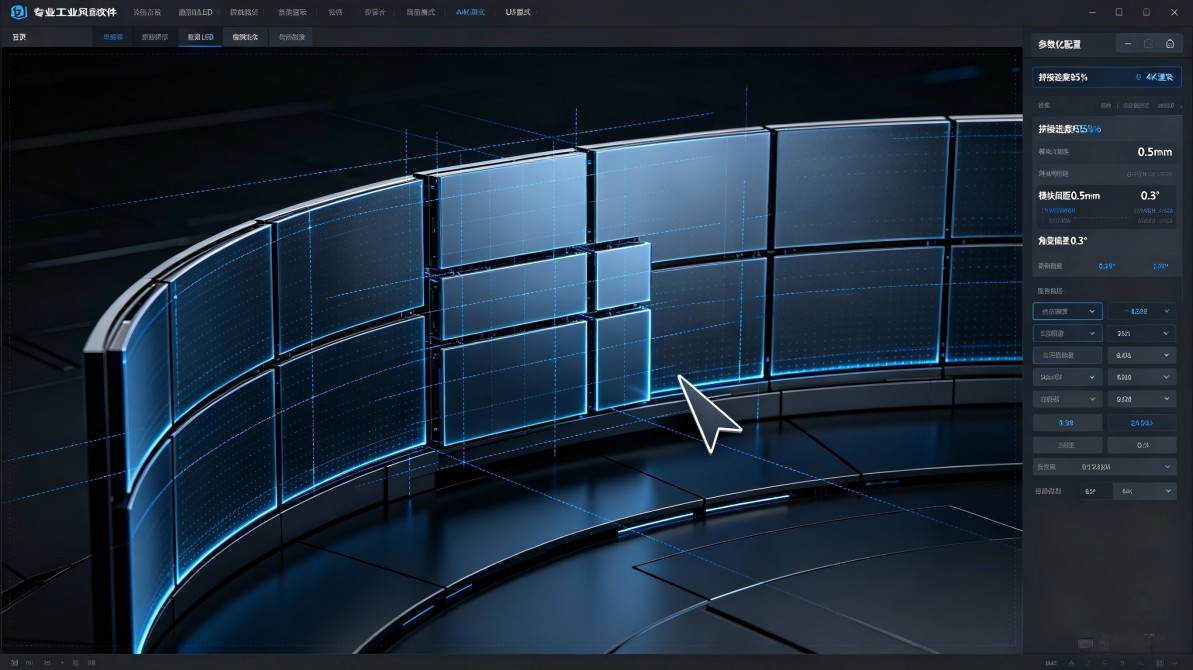
Designed for multi-screen splicing scenarios, this system achieves seamless and synchronized visual output. It employs frame-sync calibration algorithms to eliminate tearing and latency at splicing edges, ensuring consistent cross-screen imagery. It supports irregular splicing and mixed resolutions, automatically adjusting scaling and compensation. Built-in geometry correction and color temperature matching address brightness and color variations across different panels, delivering uniform image
-
Display Optical Brightness Adaptive Software
This software dynamically adjusts display brightness based on ambient light sensors and real-time algorithms, optimizing viewing comfort and energy efficiency. It maintains optimal readability under varying lighting conditions, preventing glare or dimness and reducing eye strain. The adaptive curve intelligently responds to content types (video, text, HDR) to enhance contrast performance. Furthermore, it supports multi-zone local brightness management, and extending display lifespan, making it i
-
Display Module Luminance Distribution System
This system precisely measures and analyzes the luminance uniformity of display modules, supporting pixel-level brightness mapping. Using high-precision acquisition and compensation algorithms, it identifies dark spots, bright spots, and edge roll-off, generating a correction matrix for hardware drivers to achieve full-screen brightness consistency. It outputs heatmaps and statistical reports to aid quality inspection and process improvement. For self-emissive technologies like OLED and Mini-LED
-
Full Backlight Partition Optical Simulation System
This system provides comprehensive optical simulation capabilities for direct-lit and edge-lit backlight modules. It supports optical modeling of thousands of independent local dimming zones, accurately simulating light diffusion, mixing distance, and light leakage characteristics. Using fast ray-tracing algorithms, it predicts luminance distribution and blooming effects after zone activation, optimizing backlight structure and driving strategies. The system significantly reduces physical protot



© 2026-2027 Sansys Technology (Shenzhen) Limited
